Wednesday, July 14, 2010

The Value of You

It's Wednesday night, which means that "hump day" is officially over.  "Hump day" marks the middle of the work week, and when we get over this "hump" the weekend is in sight. Do you have certain weeks that just feel extra super duper long? I had such a week just last week. Monday was a holiday and I planned to take off on Friday for a "me" day. So I had a three day week but boy, did it feel different from this week! By "hump day" last week, also a Wednesday, I was burned out. I couldn't wait to get out of the office. Today, after my third day of work this week, I'm feeling fairly good, considering I've been pulling unanticipated 10 hour days in the office. The week has passed fairly quickly and I'm looking forward to the weekend but not with the anxiety that I had last week. The reason for the change in my outlook was practicing the ultimate act of self care last Friday. On my "me" day, I took a day to do just what I wanted to do. It left me recharged and fulfilled. 
When was the last time that you took a vacation? No, not with the kids or to visit your parents or to go somewhere your partner wanted to go. When was the last time you took a day to do just what you wanted to do. For me, it was to sit in Barnes & Noble all day and work on my business, then go out to dinner with friends and catch up over a glass of wine. We all have multiple obligations, multiple people and activities to split our time between. 99.9% of us do not put ourselves on that list of people we need to spend time with or to do things for. I challenge you to do that this summer. Take a day off-I mean really off!  See a movie, go to lunch with a friend, treat yourself to a yoga class, lay on the couch all day rereading Harry Potter, whatever you'd like! And do not feel guilty about it. The value of spending a day investing in you is priceless.  You will be surprised how much more pleasant and more productive you will be.  
When was the last time you took a day for yourself?  What does your ideal day look like? When are you going to take it?

Tuesday, July 13, 2010

Meaty Mondays Series: Meat & Your Health (Part 3 of 3)

My deepest apologies for the hiatus. It has been a busy weekend filled with birthday festivities and hosting visitors from out of town. Thus, I fell behind on my blog. So I’m back this week refreshed and ready to attack the week with vigor and a new laptop!
Last week, we talked about meat and your health examining the use of antibiotics in livestock and hormones in dairy cows. I would like to speak today about the use of hormones in cattle.
It is estimated that about two-thirds of cattle in the US are injected with growth hormones. The purpose of growth hormones is quite self explanatory. By injecting hormones into cattle, they grow a lot quicker which brings the cattle to slaughter sooner, lowering costs, and increasing profits for the cattle industry. Today, there are six steroids being fed or injected into cows in the US and Canada today. The use of hormones in cattle is extremely controversial, as it is in dairy cows. Intuitively, if hormones make cattle grow, it will make humans grow. Breaking it down, if it makes cattle cells grow, it will make human cells grow, and this includes cancer cells. There are no concrete studies to prove the safety or dangers of hormone use but the human hormonal system is extremely sensitive and an imbalance can cause many issues. Hormone use in cattle has been linked to early puberty, obesity, insulin resistance and diabetes, heart disease, and even cancer.
Did you know that hormone use is prohibited in the raising of chickens and pigs in the US? In the 1930’s, DES, a synthetic hormone, was founded in the US and used in chickens. By the 1950’s the FDA saw that the hormone was building up in the tissues of men who were eating hormone injected chicken and changing the men’s hormonal activity. It caused un-descended testicles, higher pitch voices, abnormal breast enlargement, small genitalia size, impotence, infertility and increased risk for testicular cancer. Yowzers! So for obviously reasons, the use of hormones was discontinued in chicken in the 1950s. However, as the FDA was discontinuing the use of DES in chickens, they approved the use of DES in cattle. Since the 1950s, DES has been linked to more health issues and since discontinued in its use for cattle. Now, there are six approved hormones that US and Canadian cattle ranchers use.
The use of hormones in cattle is only approved for use in a handful of countries including the US and Canada. Other nations have found similar health issues to consumers of hormone injected beef as were found with those who ate hormone injected chickens. The use of hormones on beef cattle has been banned in the European Union since the 80’s. A study done in Europe found that meat from injected cattle could impact the hormonal balance of humans and cause issues in the reproductive system or cause breast, prostate or colon cancer. Furthermore, Europe banned US beef imports in 1989.
After all of this controversy, why hasn’t there been a study done to show the safety in eating meat injected or fed hormones? Well A) because it is hard to do such a study-it would require lots of time and monetary investments and B) because the cattle industry is very powerful and any indication that a study of this sort was going to be done would be squashed-and probably has been.
The cattle industry may be large, but it is not that formidable. And you are not without choices. You can cast your opinion every time you buy food-whether it be raw or prepared. Instead of beef, try to pick up an alternative like free range bison or turkey. Or better yet, get your protein from beans. Remember, you are feeding your whole self when you eat, not just your stomach.

Sources & Resources:
http://ezinearticles.com/?Factory-Farming,-Modern-Meat-Hormones,-Cervical-Cancer-And-A-Small-Penis&id=275718
http://www.organicconsumers.org/articles/article_5543.cfm
http://www.associatedcontent.com/article/97985/are_growth_hormones_in_cattle_causing.html?cat=51
DES Timeline: http://www.douglasandlondon.com/docs/DES-Timeline.pdf
EU Ban details: http://www.parliament.uk/documents/post/pn127.pdf

Thursday, July 8, 2010

Meaty Mondays Series: Meat & Your Health (Part 2 of 3)

Tuesday, I wrote about how the antibiotics in meat affects our health.  See post here.  Today I will be talking about another set of chemicals, hormones, that dairy cows receive to produce more milk. I know milk is not Meat and it brings up many other issues that does not apply to my Meaty Monday theme but it does come from the same convoluted industry and I feel like this is such an important topic. Look for info on meat and hormones in my next post.

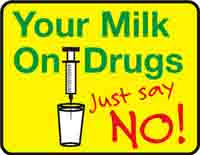
Bovine Growth Hormone (BGH) scientifically known as bovine somatotropin (BST), is a naturally occurring hormone. When ingested by baby cows, it stimulates growth. When taken by adult cows, it stimulates milk production. In the early 1990’s, scientists at Monsanto developed a synthetic version of BGH called recombinant Bovine Growth Hormone (rBGH or rBST) via biotechnology. Their goal was to sell the hormone to dairy farmers with the value that it would increase the rate of milk production. Monsanto produced an inadequate study that observed 30 rats over 90 days of rBGH exposure to the FDA. The study was never published but according to the FDA, it did not show any issues. So, the FDA approved the use of rBGH! Monsanto now sells rBGH to dairy farms across the country with the continued support of the FDA. Today, about 20% of dairy cows, the majority in large herds (500+ cows), are injected with rBGH and as a result, milk production increases 8% to 17%. That is a lot of milk for the 20 billion gallon per year industry.

Thank you, Huffington Post

The use of rBGH is extremely controversial, so much so that Canada, Australia, Japan and the European Union all have prohibited the use of rBGH! It’s unbelievable that the FDA and USDA continue to permit the use of this hormone. The label on the container of the hormones actually lists over 20 toxic side that rBGH has on cows!! Bacterial udder infections in dairy cows that are administered rBGH have increased by 25%, which increases the use of antibiotics…*shudder* Due to these infections, bacteria, blood, pus and more not-so-appetizing things secrete into the milk. And folks, that’s why our milk needs to be pasteurized… Additionally, milk from cows injected with rBGH has higher levels of a hormone call Insulin Growth Factor-1 (IGF-1). Both colon and breast cancer have been linked to people with elevated levels of IGF-1. Additionally, the countries that have banned rBGH milk have done tests of their own with outcomes that have steered them from the use of rBGH in their country.
So how can the US sell such a product? Well the answer is long and very much entangled as the relationship between Monsanto and key decision makers in the government are very close. Instead, let’s explore what you can do about hormones in your milk. Due to increasing consumer awareness and concern, some dairy products do state that they are “rBGH (or rBST) free.” Now you may have seen labels say rBGH-free but then also say “'no significant difference has been shown between milk from rBST-treated and untreated cows.” (see below) The reason for this is 100% political. Don’t believe that statement for a second. As consumers become more aware and voice their opinions, stores are responding. I know that my local Trader Joe’s has dairy products without rBGH-not sure if it’s all of them though. In 2007, grocery store chains, Kroger and Safeway, banned the use of rBGH-treated milk in their store-branded dairy products. In January 2008, Starbucks stopped using rBGH-treated milk, and in March 2008, WalMart banned rBGH use in their store-brand milk products. Now, I can’t say I’m the biggest fan of WalMart but I do believe that it does have an enormous amount of buying power in the market and am excited that they made this move. It also shows a trend in the consumer market since I’m sure WalMart only made that decision based on market demand.

Thank you Braums.com

If you do not shop at Kroger, Safeway, Trader Joe’s, or WalMart, you can check out Sustainable Table's Eat Well Guide for listings of stores, restaurants and producers who sell milk without rBGH and their rBGH-free dairy map.

My sources & great resources in general:
http://www.care2.com/greenliving/factory-farms-breed-dangerous-food.html
http://www.sustainabletable.org/issues/hormones/
http://www.sustainabletable.org/issues/rbgh/
http://www.sustainabletable.org/spread/handouts/Dairy.pdf
http://en.wikipedia.org/wiki/Bovine_somatotropin

Tuesday, July 6, 2010

Meaty Mondays Series: Meat & Your Health (Part 1 of 3)

Yes, I know. It's Tuesday but bear with me because I'm still on holiday schedule.  In honoring the primary foods of my life and recognizing that almost every work day feels like a Monday in the summer, I'm breaking up my lengthy Meaty Monday post to 4 parts this week.  Happy Reading!

The environmental impact and animal ethics of factory farming, which I covered in my Meat & the Environment and The Meatrix posts, are the basis for many vegetarian or vegans diets. It is also a big reason for the growing popularity in grass-fed and cage-free meat. Although factory farming has a big impact on the environment and the animals, are you still wondering how this directly affects you?  If that is the case, I'd like to cite some impacts of meat on your health throughout this week.  Today I'll cover antibiotics and their direct and indirect affects on your health. 
Factory farming moved livestock from the natural surroundings of sun-kissed green pastures to crowded indoor dark pens.  This change has drastically affected the health of the animals.  When confined to that space, immunity drops from lack of sun and lack of natural foods.  Disease increases and spreads rapidly.  To compensate, the "farmers" do not move the animals outside or change their profitable business model.  Instead, they feed the animals antibiotics two ways to keep them alive until slaughter.  First, they put small doses of antibiotics in their feed to maintain their health.  Kinda like how we take vitamins...kinda... Second, they treat them re-actively with more antibiotics when they become sick.  About 20 millions pounds of antibiotics is used each year on animals.  80% of it is given to animals simply to promote growth and the remaining 20% is given to treat disease.(source)  This means a) we are eating low quality meat that has been raised for quantity, NOT quality, b) we are eating unhealthy animals, c) we are ingesting antibodies, antibiotics, and dangerous bacteria,.  Does any of this sound appealing at all?

The use of antibiotics in factory farming has a direct and indirect affect on our health.  Directly and obviously, we can get sick from eating sick animals.  The living conditions that animals live under in factory farms promote contamination of feces and bacteria with the meat.  When we purchase that meat, bring it home, cook it to medium rare, slather it with some sauce and eat it, there is still bacteria in the meat.  About 76 million people become sick from their food annually.  Last week's "stomach bug" could likely be caused by the spaghetti and meatballs you ate.  Indirectly, the low doses of antibiotics cause bacteria to become resistant by mutating into stronger strains which can endanger our existence as a race.  It is growing more and more difficult to find antibiotics to fight these new bacteria.  The National Institute of Health says that it takes about 17 years for us to develop an antibody.  Bacteria can switch their genes in minutes.  One example is the H1N1 virus or the "swine" flu.  This virus was previously only seen in pigs and mutated to make humans sick.  Even with the vaccine, people caught H1N1. 

These posts contain a lot of information and are definitely not meant to scare you, but to inform.  Later on in the series, I will speak about alternatives to factory farming.  In the meantime, I would suggest that you go to your local farmers market and speak to the farmers and other patrons about alternatives to factory farmed meat.  I know that they would love to speak to you.

Stay tuned this week for more Meaty posts!  In the meantime, check out some great resources that I will be citing throughout my posts this week:
http://www.mindfully.org/Farm/Antibiotics-Factory-Farming-Facts.htm
http://www.hsus.org/farm/resources/research/pubhealth/human_health_antibiotics.html
http://www.worldwatch.org/node/1507 
http://www.care2.com/greenliving/factory-farms-breed-dangerous-food.html#
http://www.idausa.org/facts/factoryfarmfacts.html


Saturday, July 3, 2010

Tip for the Week: Happy Party Food Guilt Independence!

 (source)

Happy Independence Day!  Independence Day is one of my favorite holidays.  When I was younger, it symbolized the start of summer and still reminds me of fireflies and neon glow necklaces.  I really enjoyed seeing fireworks at Foley Field-ooo'ing and ahh'ing at the bright flower-like lights and heavily anticipating the aftermath of the "sonic booms."  Today, it still represents the quintessential summer night but the fireworks don't mean too much to me anymore.  It is really a time to get together with family and friends to enjoy each others' company and oh yeah, good food, especially BBQ.  I love food but since I have changed some of my eating behavior, I will sometimes leave a party feeling guilty about what I have eaten.  This is really the worst feeling because it is totally avoidable!
If you anticipate feeling bad about what you eat at a party today or at any time during any season, practice this party-food-guilt independence tip!   My advice is to bring your own dish to contribute to the party.  This enables you to have more control over what you put into your mouth.  This doesn't mean you can't enjoy the other food that you normally would eat at a BBQ but you can feel good that some space in your belly that would have otherwise been filled with chips and dip is instead filled with your healthy choice.  Some suggestions for what you can bring:
  • Appetizer/side: peppers to roast (these can be added into salads or upgrade your hamburger), quinoa salad (what a great opportunity to teach people about quinoa!), pre-soaked corn to roast, rice and beans
  • Main dish: ground turkey to make turkey burgers, salad loaded with lots of vegetables, whole portabella mushrooms to make burgers instead of a meat based burger-better yet, ditch the bun!
  • Dessert: fruit salad or just a whole watermelon (who doesn't like watermelon?), even better-a watermelon bowl fruit salad
  • Drinks: fresh lemonade (not great but better than the soft drinks with high fructose corn syrup), soda/sparkling water
Besides leaving a party guilt free, you will also look like a great guest.  Most hosts will be grateful for more food to serve.  I know that I am always thankful when my guests bring something.
So here you go. The ultimate party food guilt independence tip for your Independence Day celebration!

Friday, July 2, 2010

What are Obesity Rates in your State?

A recent article stated that more than two-thirds of states in the US have adult obesity rates of 25% or more!  This statistic is staggering because just 10 years ago, in 2000, no state had rates over 20%-24%.  The country is undergoing a serious epidemic of widespread obesity.  These maps below show the evolution of obesity in this country since 1985.  In most of my lifetime, the country has gone from not having even tracked obesity to having six states with more than 30% obese adults.

Twenty years ago, they didn't even need the four of the colors! 
(for less fuzzy numbers see the source)

These maps are an indication of an extreme not only healthcare, but also financial issue in the US.  By 2018, the country will be spending ~$340 billion annually on obesity-TRIPLING current levels! (source).  Additionally, obesity is linked to many lifestyle diseases which lead to premature death.

In rank order, the 15 leading causes of deaths in 2005 were 1) Diseases of heart (heart disease), 2) Malignant neoplasms (cancer), 3) Cerebrovascular diseases (stroke), 4) Chronic lower respiratory diseases, 5) Accidents (unintentional injuries), 6) Diabetes mellitus (diabetes), 7) Alzheimer’s disease, 8) Influenza and pneumonia, 9) Nephritis, nephrotic syndrome and nephrosis (kidney disease), 10) Septicemia, 11) Intentional self-harm (suicide), 12) Chronic liver disease and cirrhosis, 13) Essential (primary) hypertension and hypertensive renal disease (hypertension), 14) Parkinson’s disease, and 15) Assault (homicide). (source)  Twelve of the fifteen top causes are lifestyle related and almost all of them can be linked to obesity.  Those twelve causes make up almost 73% of deaths in the US.  Imagine if we took preventative measures towards obesity before people developed lifestyle diseases like diabetes, heart disease, and cancer.  The healthcare system could focus on health-not disease and the country would not have the financial troubles that it has now.  The US would have a healthier population and in my opinion, a more productive workforce which in turn would help the economy even more!  The army has recently stated that they are have issues recruiting because so much of the younger population is obese.  So obesity is even affecting national security!

Obesity is literally and figuratively a very large problem.  Groups around the country are starting to form to combat this epidemic.  The government is starting to look at the obesity issue and taking strides against it with Michelle Obama's Let's Move program, a promising healthcare legislation is in the works and an increased focus on childhood obesity is happening everywhere including on TV with Jamie Oliver's Food  Revolution and reality shows.  What can you do in your neighborhood to help fight the problem?  Can you start in your home and start educating your family or roommates?  How about only bringing healthful items into your home so you don't turn to the bag of  chips when you are too tired to make dinner?  Would your community be interested if you started a walk or run club in your neighborhood?  Ever thought of hosting a healthy potluck?  The obesity issue is not going away anytime soon.  Efforts need to be made on a large and small scale to attach the problem from all angles.  What are you going to do about it?

Here are some sources you can check out for more information on obesity: 
Obesity Rates Jump in 28 States, Report Shows
F: As in Fat  How Obesity Threatens America's Future 
CDC US Obesity Trends
National Vital Statistics: Deaths-Final Data for 2005

Thursday, July 1, 2010

Today's Yogi Tea Quote

I realized last week that I have not drank tea in a while.  Maybe it's been the warmer weather but I'm basically just drinking water and the occasional coffee, coconut water, and kombucha.  I missed the relaxation I immediately felt from inhaling the steam from an herbal tea.  This afternoon felt like a tea afternoon so I pulled out my Yogi Tea Kava blend for Stress Relief from the depths of my desk drawer.  It's brewing right now and I thought I'd share the quote from the tea bag.  I think I look more forward to the quote than I do the tea itself.  :)

"Noble language and behaviors are so powerful that hearts can be melted."

How about you? Are you a tea drinker?  Haven't in a while?  Do you have a quote to share from your Yogi Tea today?